Here are some excerpts from very informative articles which show how raising animals for food has a direct impact on the environment and on our health. These articles are so interesting and important, it would be a shame to miss reading them. Links to the original articles are posted below the excerpts.
The Impact on the Environment
Here are some numbers from the PETA site, an organization that informs and cares about the treatment of animals.
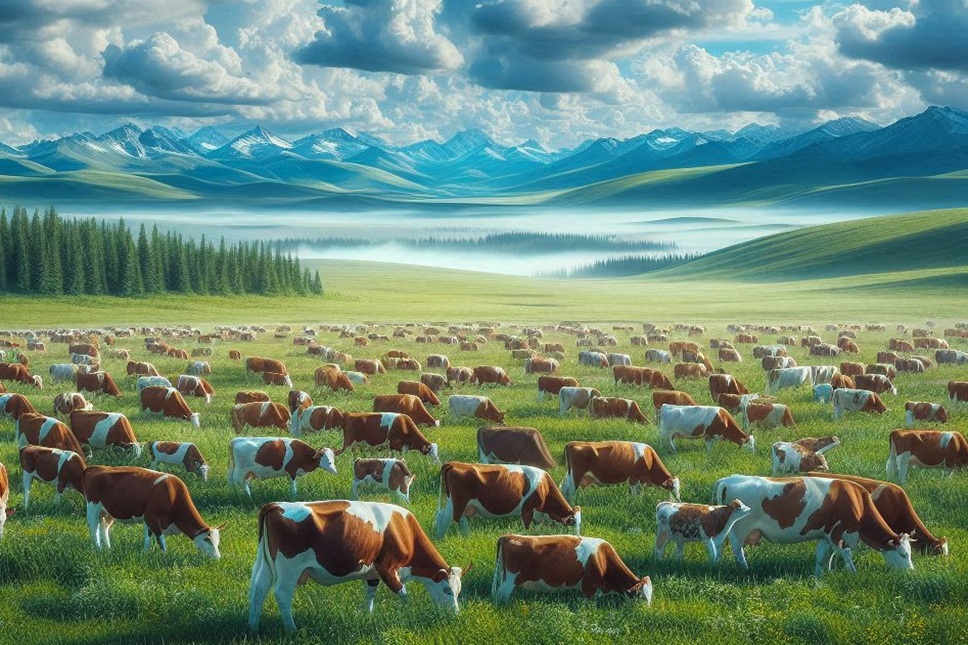
- “When land is used to raise animals instead of crops, we lose water and land, trees are cut down to make room for pastures or factory farm sheds, and untreated animal waste pollutes rivers and streams. […] Cows must consume 16 pounds (1 lb=0.45 kg) of vegetation in order to convert it into 1 pound of meat.
- Raising animals for food uses more than half of all the water used in the United States. It takes 2500 gallons of water (1 gallon=3.78 l) to produce one pound of meat, but only 25 gallons to produce one pound of wheat.
- Producing a single hamburger uses enough fuel to drive a small car a distance of 32 kilometers. Of all the raw materials and petroleum used in the United States, more than a third goes into raising animals for food.
- A typical hog factory generates the same amount of raw waste as a town of 12,000 people. According to the Environmental Protection Agency, raising animals for food is the number one source of water pollution.”
The Impact on Our Health
Here is an excerpt from a guardian.com article.
“There are a number of concerns about the impacts of industrial meat production on our own health, beyond environmental issues. Bacterial infections that can be transmitted to humans, such as salmonella and campylobacter, can spread on large farms. The ability of these pathogens to enter the environment around farms and slaughterhouses, and to make humans sick, is a major modern concern.
Although there is a problematic dearth of research on the link between antibiotic use in animals and the growing problem of antibiotic resistance in humans, scientists and policymakers agree that it is an important part of the problem. The volumes here are significant: in the United States, an estimated 80% of all antibiotics are for farm animals.”
See the original article here.
Here are a few lines from a Washington Post article also.
“A research division of the World Health Organization announced on Monday that bacon, sausages and other processed meats cause cancer, and red meat probably does too. The WHO findings were written by a panel of 22 international experts who reviewed decades of research on the link between red meat, processed meats and cancer.
The panel looked at animal experiments, human food and health studies, and cellular mechanisms that could lead red meat to cancer. In reaching its conclusion on red meat, the panel ‘considered all relevant data, including substantial epidemiological data showing a positive association between red meat consumption and colorectal cancer and strong mechanistic evidence,’ according to a statement released by the band on The Lancet’s website.
The panel also cited studies suggesting that eating an extra 100 grams of red meat daily increases the risk of colorectal cancer by 17%; eating an extra 50 grams of processed meat daily increases the risk by 18%, according to the cited research.”
Read the original article here.
The Impact on Our Hearts and Minds
From my personal experience, I know that being a vegetarian has developed in me a true compassion for animals; and this compassion transformed my perception of these beings and it change yours also. Compassion transforms hearts.